
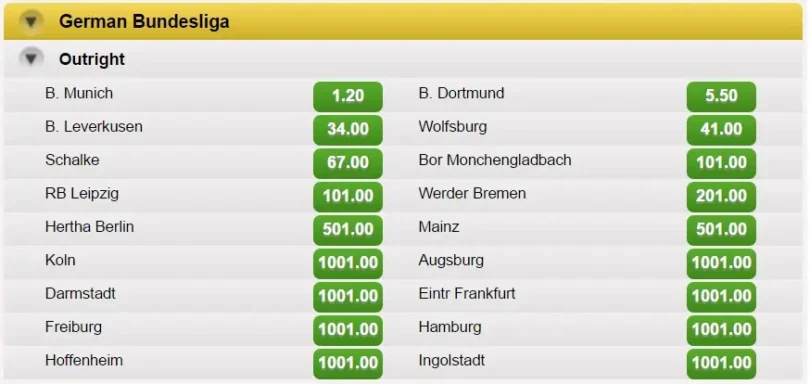
The 2016–17 Bundesliga season is a compact laboratory for learning how to judge whether betting odds are “worth it” rather than just attractive on the surface. With Bayern dominating, Leipzig and Dortmund chasing, and a compressed mid-table, real bettors had to decide when short prices on favourites or long prices on underdogs actually represented value, not just narrative.
What “Value” in Bundesliga Odds Really Means
For an experienced bettor, value is not about whether a favourite wins or an underdog pulls off an upset; it is about whether the odds offered a higher return than the true probability justified. Across 2016–17, markets routinely installed Bayern as heavy favourites and relegation candidates as outsiders, but that did not automatically tell you whether the price on any given match was fair or skewed. Instead, the cause–effect chain runs through comparison: you estimate a team’s win/draw/loss chances based on performance, context and statistics, then compare those estimates to the implied probabilities in the odds to see if there is a positive edge or a hidden tax.
How the 2016–17 Table Framed Pre-Season and In-Season Prices
The final standings show Bayern winning the league with 82 points, followed by RB Leipzig, Dortmund and Hoffenheim, while Ingolstadt and Darmstadt were relegated. Even before the season started, outright markets and match odds reflected expectations that Bayern would dominate, Leipzig would be a question mark as a promoted side, and traditional clubs with mid-table budgets would sit in the middle; as the season progressed and results confirmed some narratives, odds adjusted but not always perfectly. For real bettors, this meant value arose where the market underreacted—like underpriced Leipzig early in their surge—or overreacted to short-term swings, such as temporarily inflating or depressing prices on mid-table sides after a streak.
Where Bayern’s Dominance Created and Destroyed Value
Bayern’s fifth consecutive title and large goal difference illustrate why they were short-priced almost every week, especially at home. Many bettors instinctively backed them in accumulators and large handicaps, assuming the gap between Bayern and the rest guaranteed both wins and big margins, but the odds often implied win probabilities above 80–85%, leaving very little margin for error. The impact was that any draw or surprise loss wiped out multiple low-edge tickets, meaning that even a team with 25 wins in 34 games could be a poor value proposition if bettors consistently paid too much in implied probability for those victories.
From a real-player perspective, the more interesting Bayern positions were often situational: when schedule congestion, rotation or tough away fixtures slightly widened the odds, creating rare spots where the market’s caution produced a small positive edge. Conversely, when prices were extremely short with little contextual risk, value-seeking bettors often passed, recognising that not betting a match can be the most rational decision.
How Emerging Teams Like Leipzig Generated Early-Season Edges
RB Leipzig’s 2016–17 campaign, finishing second in their first Bundesliga season, demonstrates how markets can lag behind reality. Early in the season, when they were still perceived as a promoted side rather than a genuine contender, their match odds often implied lower win probabilities than their underlying performances and tactical clarity justified, especially at home where their pressing and energy created sustained pressure. Real bettors who watched both results and performances could identify that their aggressive style translated into consistent chances and wins, turning initial “upsets” into a pattern that the odds were slow to fully encode.
However, as Leipzig’s results accumulated and media attention grew, their prices tightened, and the same bets that offered clear value early on became closer to fair or even overpriced. The outcome for disciplined bettors was a shift: from eagerly backing Leipzig when the market underrated them, to selectively fading them when their odds began to reflect hype rather than a sober reading of their true chances, especially in tough away fixtures or during congested periods.
Mid-Table Confusion: When the Table Misled the Market
The mid-table band—from roughly Köln down through Freiburg and Leverkusen—ended the season with points clustered within a relatively narrow range, despite significant differences in goal difference and performance patterns. This clustering meant that two teams separated by several places in the table might actually be closely matched in strength, or even reversed when you considered goal difference and consistency; yet match odds often leaned heavily on current table position. The effect was that a slightly higher-placed side could be priced too short at home against an opponent with similar or better underlying numbers, creating underdog value for bettors willing to look past the standings.
Real players viewing 2016–17 retrospectively often recall situations where a mid-table home favourite was odds-on despite a modest goal difference and patchy form, while the visitor with equal scoring power and tighter defence was priced generously. In those cases, value existed not in picking glorious upsets at random, but in systematically opposing shallow table-based pricing whenever the deeper stats indicated near-parity.
Mechanism: Converting Odds into Implied Probability
To formalise value judgments, many bettors translate decimal odds into implied probabilities and compare them with their own estimates. For example:
- Decimal odds 1.50 → implied probability ≈ 66.7%.
- Decimal odds 2.50 → implied probability ≈ 40%.
- Decimal odds 3.50 → implied probability ≈ 28.6%.
If your analysis of a 2016–17 matchup suggested that Dortmund had a 60% chance to win a specific home match but the market priced them at 1.50 (66.7%), you would see that as negative value despite their strength: the price assumes more dominance than your model supports. Conversely, if a mid-table underdog appeared at 3.50 but you believed they had a 35–40% realistic chance—owing to injuries on the favourite’s side or strong home metrics—then the same calculation would reveal positive value. The mechanism hinges on this comparison, not on guessing outcomes: even losing bets can be good decisions if the price was in your favour.
How UFABET Can Be Used to Track and Test Value Perceptions
When a bettor wants to operationalise this thinking in a live environment, the way they use their account matters. In a scenario where someone relies on UFABET, the analytical edge comes from using that betting platform as a structured workspace: before each round they can list a handful of Bundesliga fixtures, write down their own estimated probabilities for each outcome based on 2016–17-style reasoning (form, injuries, schedule, stats), then compare those probabilities to the implied chances in the odds displayed. By recording which discrepancies they act on and how those decisions perform over a block of matches, they can see whether their value judgments add up or whether bias—overrating big names, underestimating resilient underdogs—needs correcting.
This approach reflects how many real bettors grow: not by chasing one-off “tips,” but by repeatedly checking whether their internal pricing beats what ufabet168 offers in the long run. In the context of a season like 2016–17, they might discover that their biggest edges came from underappreciated teams in the middle of the table, or from avoiding low-edge favourites even when those favourites often won.
Where casino online Sits in Relation to Value-Based Sports Betting
A value-focused approach in football betting is built on modeling probabilities, interpreting performance data and testing beliefs against market prices; it is fundamentally different from the way most people interact with games in a casino online environment. In a casino, the rules and house edge are fixed, and no amount of observation during 2016–17 or any other season can transform roulette or slots into positive-expected-value propositions over time, even if short streaks temporarily suggest otherwise. For bettors who divide their time between Bundesliga analysis and a casino online website, recognising this difference is crucial: one activity allows for skill in estimating fair odds, while the other is largely entertainment with negative expectation.
The practical implication is that mixing the two without clear boundaries often erodes the discipline needed for value betting. Losses in casino sessions can push a bettor to force value where none exists in football markets, while unexpected casino wins may invite reckless enlargement of stakes. Treating casino play as a separate, capped leisure activity preserves the mental clarity needed to evaluate whether a Bundesliga price is genuinely “worth it.”
Value Lessons from Overperformers and Underperformers
Even without full access to bookmakers’ historical odds for every match, you can still draw useful value lessons by comparing team outcomes with pre-season and mid-season expectations. Bayern’s comfortable title followed forecasts, offering few outright surprises; Leipzig’s rise from promoted club to runner-up clearly outperformed typical projections; and Freiburg’s respectable points total despite a negative goal difference hints at marginal overperformance in close games. Each pattern carries a distinct value signal: teams matching expectations are often fairly priced, overperformers offer early-season value before markets catch up, and sides living off one-goal wins may have their prices inflated by results that outpace underlying strength.
At the opposite extreme, relegated sides and fragile survivors who finished with poor goal differences and low points often delivered fewer genuine value spots than their long odds suggested. From a real bettor’s point of view, regularly backing such teams on the basis that “the price is huge” confuses price with probability; the odds can be big yet still fail to reflect true weakness, meaning even occasional wins do not compensate for frequent losses.
Summary
From a real bettor’s standpoint, evaluating the value of 2016–17 Bundesliga odds meant more than remembering who won or lost; it required continuous comparison between team performance, implied probabilities and personal estimates. The league’s structure—with Bayern’s dominance, Leipzig’s rapid rise and a congested mid-table—created repeated situations where markets either lagged behind emerging realities or leaned too heavily on surface-level indicators like position. When you respond by translating odds into probabilities, testing your own numbers against what bookmakers offer, using structured environments intelligently and keeping high-variance casino activity conceptually separate, you move from reacting to prices emotionally to judging whether they truly offer value in the long run.


Leave a Comment