
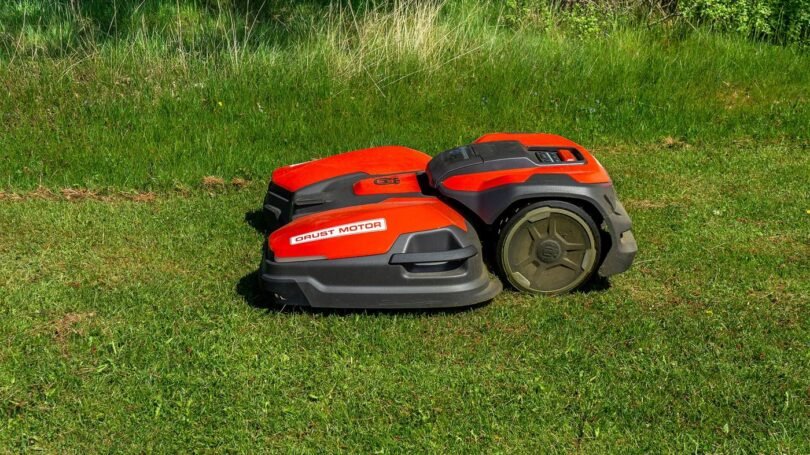
For thirty years, a robot lawn mower meant a buried wire. Installing the perimeter cable took a professional half a day, and moving a flower bed meant digging it up again, which kept the machines a niche for keen gardeners. That wire is now disappearing. Wire-free models rose from 35 percent of global robotic mower sales in 2024 to 65 percent in the first half of 2025, when 2.34 million smart mowers were sold, a jump of 327 percent on the year before. Husqvarna, which launched the first robotic mower three decades ago, added 13 wire-free models for the 2025 season, taking its range to 24. Segway’s Navimow passed its millionth unit in April 2026, and Mammotion’s LUBA 3 uses satellite positioning, LiDAR and cameras together to place itself within a centimetre. The boundary is now drawn on a phone screen.
What the Evidence Shows
Buying one starts with the lawn, not the mower. The buyer should measure the area and the slopes, since small machines suit flat gardens under a few hundred square metres while large and all-wheel-drive models handle steep ground and lawns of several thousand square metres. Obstacles matter too: toys, hoses and low branches confuse cheaper machines, while camera and LiDAR models steer around them, and most mowers now return to their dock when it rains. Security is worth checking, since a mower left outside can be stolen, so GPS tracking and a PIN lock are useful, and some models sound an alarm when lifted. Prices run from about 999 dollars for an entry model to 3,000 dollars for a flagship, and the running cost is small: the mower trims a little grass every day, mulching the clippings back into the lawn, so there is no bag to empty and no petrol to buy. Reporting and analysis from sources such as IEEE Spectrum track the same developments, and specialists following robot lawn mowers say the direction is now consistent across independent lines of evidence.
The Wider Context
Adoption of robot lawn mowers follows a familiar pattern with an unfamiliar speed. Early users tolerate rough edges in exchange for advantage, mainstream users arrive when the tool disappears into existing workflows, and the market consolidates around whoever made that transition feel effortless. Vendors are racing less on raw performance now than on integration, support and trust.
What Happens Next
The realistic forecast for robot lawn mowers is steady integration rather than sudden replacement: embedded in products people already use, improving in increments, and regulated in proportion to its reach. The companies and institutions that plan on that basis, training staff and redesigning processes instead of chasing launches, are the ones the adoption data tends to vindicate. You can follow related developments in our coverage of technology.
It is also worth remembering how quickly the picture in this area has changed before. Positions that looked settled a few years ago have been revised as new data arrived, and the same humility is appropriate now. The strongest coverage of this subject, and the most useful advice, tends to come from sources that update their views openly when the facts move, rather than defending an earlier position long after it has stopped fitting the evidence available.






Leave a Comment