
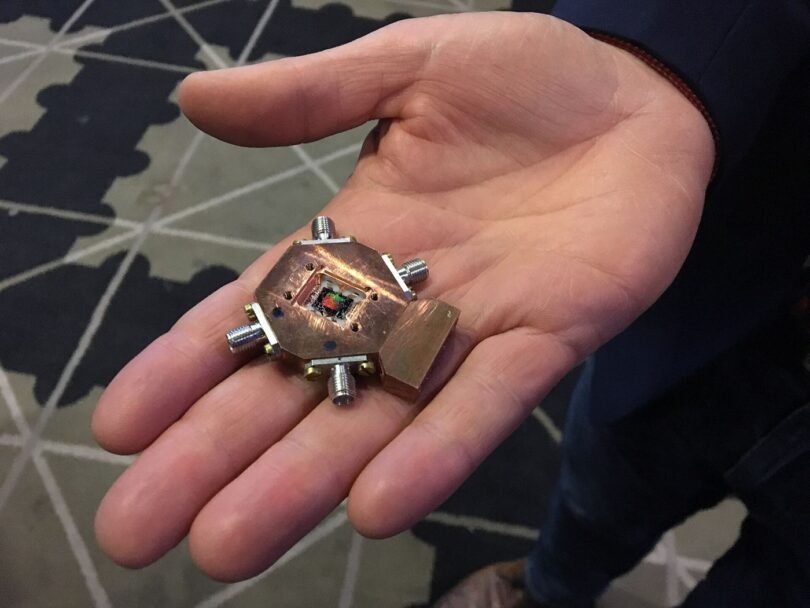
Google Quantum AI has demonstrated a new quantum computing breakthrough with its Willow processor, winning a specialised coordination game 98.30 percent of the time and beating the 88.89 percent success limit achievable by any classical strategy. The results, announced on November 19, 2026, and published in the journal Science, were run on 72-qubit and 105-qubit Willow processors across 900,000 rounds of the Mermin-Peres magic square game. Two players sharing two entangled Bell pairs coordinated their answers using quantum correlations, something classical players cannot match under the same rules. In a separate experiment, researchers coordinated up to 71 qubits in a multiplayer parity game, staying above the classical limits, and a shallow-circuit algorithm on up to 105 qubits beat its classical bound of 50 percent.
What the Evidence Shows
The findings extend Google’s earlier Willow error-reduction breakthrough and strengthen its position in a race that includes IBM, which expanded its Nighthawk family to a 520-qubit processor in November 2026, and Quantinuum and IonQ in trapped ions. In October 2026, Google demonstrated high-fidelity magic state cultivation on Willow, reaching 99.99 percent fidelity for non-Clifford states, a key step toward fault-tolerant machines. The new test is not a claim of general-purpose quantum advantage, but a measured quantum-classical separation: it proves the hardware can solve certain structured problems more reliably than conventional approaches. The practical payoff is still years away, and error correction remains the field’s central challenge, with Google’s own November 16 paper showing leakage into a third excited state limiting surface-code stability. Reporting and analysis from sources such as Nature track the same developments, and specialists following Google Willow quantum test say the direction is now consistent across independent lines of evidence.
The Wider Context
The wider context is a research landscape in which replication and open data now decide reputations. Findings connected to Google Willow quantum test are being checked by independent groups with shared datasets, and the teams involved publish their methods in full so rivals can test every step. That discipline is slower than a headline cycle, but it is why results in this area increasingly survive first contact with scrutiny.
What Happens Next
What happens next in the story of Google Willow quantum test will be decided by follow-up work already under way: larger samples, longer observation and instruments that have not yet come online. The researchers involved are unusually united on one point, that the current results justify the next investment of time and money. Readers will not have to wait long for the first tests of that claim. You can follow related developments in our coverage of science.
None of this will be settled by a single announcement, study or product launch. The pattern to watch is accumulation: independent confirmations, honest reporting of failures and steady improvement in the underlying numbers. Readers who follow those signals, rather than the loudest claim of the week, will understand this subject better than most of the commentary surrounding it suggests is possible.





Leave a Comment